What this is
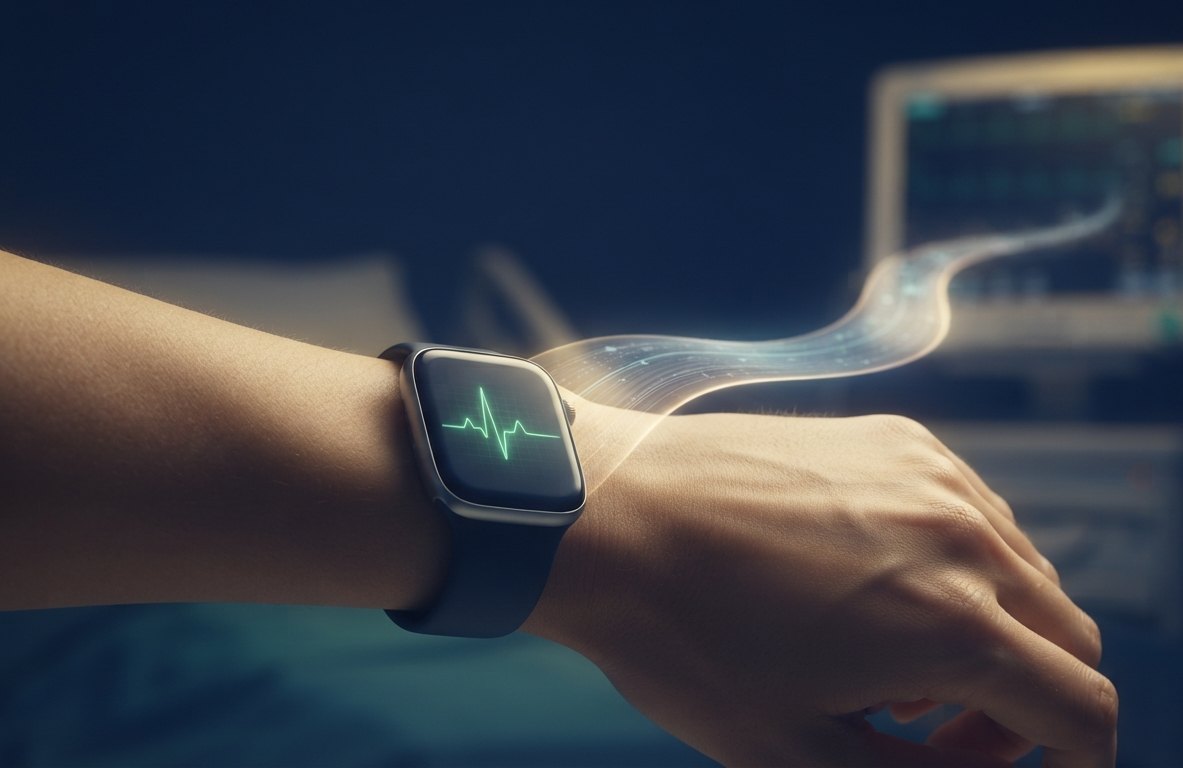
AEGIS Health is the metabolic tier of a single wearable platform. The same watch a person already wears for lifestyle and cardiac watch adds a non-invasive glucose reading — blood glucose estimated from an infrared optical sensor against the skin, alongside SpO₂ from the same optics. There is no finger-prick and no disposable strip. A separate 4-lead Bluetooth ECG band (the RA · LA · RL · LL limb leads) streams the heart trace to the same engine when a clinical-grade tracing is wanted; the two metal contacts on the back of the watch are for charging, not sensing.
Read this first — what is demonstrated, and what is designed-for. What is built and shown here is the engine and the index: a damped-oscillator model of the glucose response, a dimensionless diabetic index A derived from it, and an adaptive classifier/regressor that learns each wearer. The dimensionless-index approach is validated on open, physician-labelled diabetes data (the DRAS lineage, AUC ≈ 0.96 on diabetes classification). The non-invasive infrared glucose sensor itself is a planned integration — designed for, not yet validated on real device signals. This page states that plainly on purpose, so the claim stays credible.
The glucose model — a damped oscillator
After a meal, blood glucose rises, overshoots, and settles — and a healthy body damps that swing quickly, while a diabetic one rings for longer and settles higher. AEGIS models that curve directly as a damped oscillator: the same physics that describes a weight on a spring easing back to rest. Two numbers do the work — how fast the swing decays and how far it overshoots — and from them the model reads out a single dimensionless diabetic index A. Because the index is dimensionless, it compares people and days on one scale without depending on units, sensor gain, or the exact meal.
Paired with it is an artificial-pancreas insulin-control model: a pulse-then-wait controller that fires a correction, waits for the body to respond, and re-fires — clamped so it never drives glucose below a safe baseline. Together they turn a noisy glucose trace into a short, honest summary a person (and, with consent, a clinician) can act on.
One engine, time-shared — never idle
A wrist wearable has one small processor and a tight power budget. Rather than run separate models for glucose, oxygen and heart, AEGIS runs one adaptive AI engine that time-shares across all of them — a scheme borrowed from time-division multiplexing. In each slice the engine attends to one signal (glucose, then SpO₂, then ECG, then skin), so no channel is dropped and the core is never sitting idle. One engine, many senses, on a battery that has to last the day.
The part that matters: it learns you
The strongest claim of this platform is not any single number — it is that the engine adapts on four axes at once, with a human always in command:
| Adaptive axis | What it means, plainly |
|---|
| Per person | The watch calibrates to your body on the device itself — your resting normal, your meal response — instead of assuming an average wearer. |
| Over time | A “grey window” watches for drift; when your baseline moves, it re-learns rather than quietly going wrong. |
| To context | A fuzzy in-range band widens or tightens with what you are doing — resting, moving, eating — so a normal swing is not read as an alarm. |
| Across sensors | What it learns from one signal transfers to help read the others, so a new sensor starts smarter. |
On the rim of any reading — where the model is unsure — the system defers to the person and, where relevant, a clinician. It flags; a human decides.
The base station — all four technologies on one glass panel
The wearable docks in a base-station stand that charges it and receives the Bluetooth ECG. Its display is a transparent glass control panel — you can see through it — edged with a thin glowing rim, and it is a touch screen. On one panel it shows all four AEGIS technologies at once: Lifestyle, Clinical (the hospital-desktop cardiac tier), Health Continuous Monitoring (glucose · ECG · SpO₂), and Emotional (psychophysiological support) — with a System-Level Adaptive Engine band across the top making the four adaptive axes visible. Tap a tile to focus it.
Live · the base-station control panel
Transparent glass, thin glowing edge, touch to focus a tile. The watch sits in the dock, charging, while the 4-lead ECG streams in. Drag to rotate.
One platform, four technologies
AEGIS Health does not stand alone. It is one pocket of a single wearable that carries the technologies for Lifestyle, Clinical (validated on 66,951 physician-labelled ECGs across two independent datasets), Health Continuous Monitoring (this page — glucose, ECG, SpO₂), and Emotional support. One device on the wrist, one engine underneath, four ways it looks after the person wearing it.
Stated plainly, so it stays credible. This is a feasibility demonstration of a method — a damped-oscillator glucose model, a dimensionless diabetic index, and an adaptive per-wearer engine — presented as an interactive 3D prototype, not a certified medical device. The non-invasive glucose sensor is a designed-for integration; forward-validation against repeated HbA1c, real on-device SpO₂/ECG, and a bio-impedance channel are open items on the roadmap. It flags; a person, and in time a certified pathway, decides. Dedicated to Professor Dhanjoo N. Ghista, whose nondimensional-index lineage this work continues.