What this is
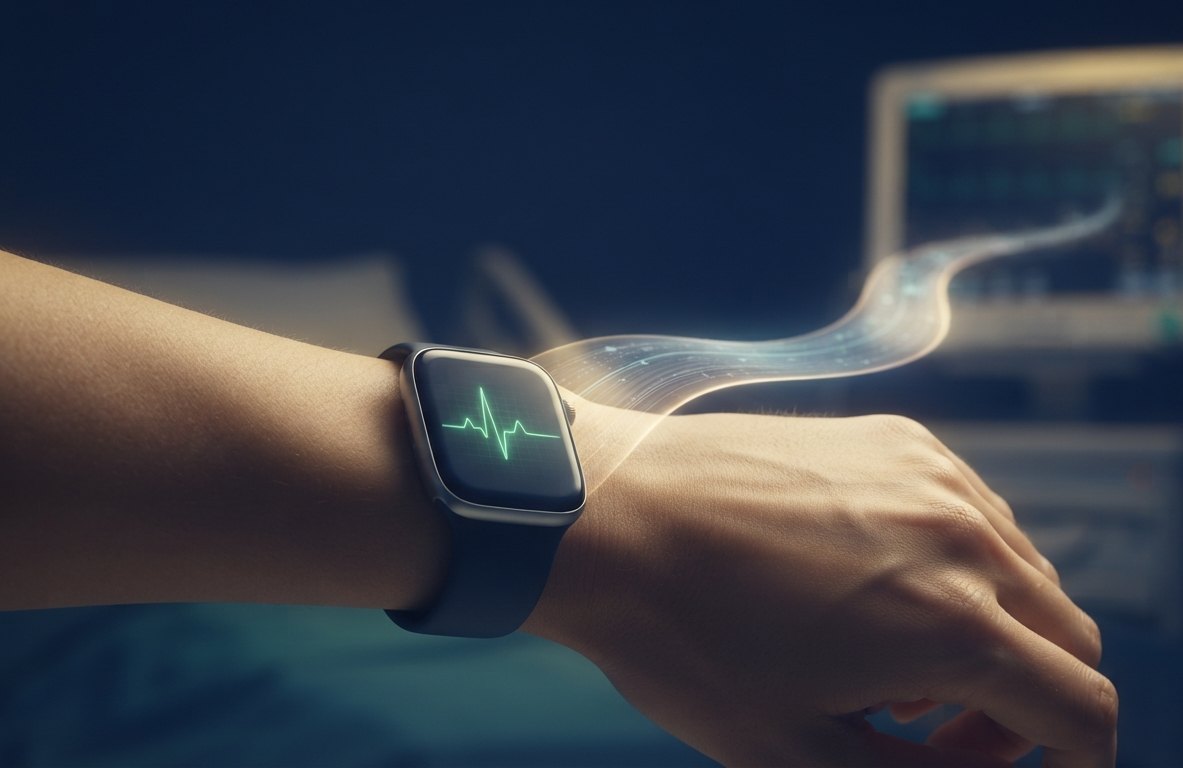
AEGIS Emotional is the psychophysiological tier of a single wearable platform. The same band a person wears through the day reads the autonomic signature of stress — electrodermal activity (skin conductance), heart rate and its variability, skin temperature, and motion — and turns it into a live, plain-language read of how the body is coping. There is no diary and no self-report: the signals are continuous, and the engine calibrates to the individual rather than to an average person.
Read this first — what is demonstrated, and what is designed-for. What is built and shown here is the engine, the index and the Sentinel: a per-person feature engine, a defer-to-human grey-zone classifier/regressor, the Ψ nondimensional arousal index, and a live human-face display. These are validated on open, labelled affective datasets (the PhysioNet Non-EEG cohort; WESAD extracted for the emotional axis). Honestly stated: this is a strong moment-to-moment arousal / stress-load reader and a powerful longitudinal mood / resilience tracker — not a discrete-emotion namer and not a diagnosis. A human is always in command.
It reads you — calibrated to your own calm
Resting skin conductance varies roughly 179× between people, so an absolute threshold is meaningless. AEGIS z-scores every signal to your own Relax baseline — the core idea — so only your deviation from your calm counts. From those calibrated signals a single Ψ (Psi) arousal index — a weighted root-mean-square of the autonomic markers, floored at your personal calm — rises monotonically from rest to stress. On the honest subject-independent test (Leave-One-Subject-Out, the wearer never seen in training) the stress-vs-calm detector reaches ROC-AUC ≈ 0.92, deferring only the uncertain ~10% of moments to a human.
Four states, and the honest limit
The Sentinel resolves four non-EEG states — Relax, Cognitive load, Emotional stress, and Physical exertion — each at an intensity from mild to extreme, shown on a human face. An activity gate (the motion channel) separates a racing heart from a run versus a racing heart from distress — without it, exertion masquerades as emotion. The honest boundary is arousal vs valence: the wrist reads how activated you are strongly, but whether it is pleasant or unpleasant weakly — true valence needs facial signals the wrist cannot see. So on the rim, where cognitive and emotional stress look alike, the Sentinel says so and defers.
| Adaptive axis | What it means, plainly |
|---|
| Per person | The band calibrates to your calm baseline on the device — your resting normal — instead of assuming an average wearer. |
| Over time | A “grey window” tracks drift; as your baseline moves (sleep, illness, training), it re-learns rather than quietly going wrong. |
| To context | The motion gate widens or tightens the read — resting, moving, exerting — so a normal exertion swing is not read as an emotional alarm. |
| Defer-to-human | On the rim — high arousal but ambiguous type — it flags uncertainty and offers to contact a caregiver. It flags; a person decides. |
The grey-zone engine — why fuzzy fits the body
Human physiological signals are fuzzy: imprecise, person-specific, and graded rather than crisp. So the primary engine gives a graded closest-fit output with a native grey zone, not a hard split. AEGIS runs the whole grey-zone family — SVM (signed margin), SVR / Nu (ε-tube), and native fuzzy-inference (Mamdani, ANFIS, Interval Type-2) — and on an equal footing they tie (SVR ≈ SVM ≈ ANFIS within 0.01). The learned fuzzy engine (ANFIS) is the most cautious — it defers more — but is surest when it does act, exactly the profile a human-in-command safety wearable wants. Tree ensembles are kept only as a reference benchmark; they have no grey zone, so they are not used to decide.
Part of the reusable AEGIS model framework: a 39-engine roster — the 19-model standard board, the Fuzzy SVM/SVR/Nu family carried since P16, and the 3 native fuzzy-inference engines added here — every wearable judgement made inside the person’s grey band.
One platform, four technologies
AEGIS Emotional does not stand alone. It is one pocket of a single wearable that carries the technologies for Lifestyle, Clinical (validated on 66,951 physician-labelled ECGs across two independent datasets), Health Continuous Monitoring (glucose, ECG, SpO₂), and Emotional (this page — stress, arousal, cognitive load, recovery). One device on the wrist, one engine underneath, four ways it looks after the person wearing it.
Stated plainly, so it stays credible. This is a feasibility demonstration of a method — a per-person feature engine, a defer-to-human grey-zone model, the Ψ arousal index, and a live human-face Sentinel — presented as an interactive in-browser prototype, not a certified medical device. It reads arousal and stress-load well; it does not name a discrete emotion and does not diagnose. Escalation to a caregiver is always an offered action a person confirms, never an automatic call. Dedicated to Professor Dhanjoo N. Ghista, whose nondimensional-index lineage this work continues.