SEAL Team · streaming on Netflix · AEGIS Diagnostic Augmenting Systems

The War Comes Home With Them

Two of SEAL Team's most-watched storylines aren't about the mission — they're about what the mission leaves behind. One is a brain injury nobody on the team wants to admit is happening. The other is a limb that isn't there anymore, but still won't stop talking. Both are television. Both are also, for hundreds of thousands of real people, Tuesday.

Filed by AEGIS Diagnostic Augmenting Systems — subjects: traumatic brain injury · phantom limb pain

SEAL Team ran seven seasons on CBS and Paramount+ before landing on Netflix this August — and the wider audience found two storylines the show treats with unusual seriousness. The team's leader develops a brain injury he hides from the men who trust him with their lives. His closest operator loses a leg and comes back to a body that argues with him. Neither storyline is played for shock. Both are played for exactly how disorienting, slow, and unglamorous these injuries actually are — which is, unusually for network television, close to the truth.

We build diagnostic AI research for exactly these two conditions. So we're using the show's audience to do something we think is more useful than a normal recap: tell you what's real, what's fiction, and what our own research — Project 26 and Project 26B — actually is and isn't, right now, honestly.

Case File 01

The Invisible Wound

Subject: Master Chief Jason Hayes  ·  character, played by David Boreanaz  ·  SEAL Team, Season 5

Across Season 5, Jason Hayes's character starts missing things: a name, a step in a plan, the thread of his own sentence. Headaches that don't quit. Moments where his judgment — the one thing a team leader can't afford to lose — becomes the thing his team quietly starts worrying about. He hides it as long as he can, because admitting it means the job might end.

The show never puts a diagnosis on screen. It doesn't need to. What it's depicting — a brain injury whose symptoms show up as behavior before they show up as anything a scan can point to — is one of the most common and most under-reported injuries in medicine.

69,473
TBI-related deaths in the United States in 2021 — roughly 190 people a day. CDC, Facts About TBI.
414K+
TBI diagnoses among U.S. service members worldwide, 2000–2019 — the population Jason Hayes's character represents. Defense and Veterans Brain Injury Center.
185K+
Veterans currently in VA care for at least one diagnosed TBI, most classified as mild — the ones easiest to miss. U.S. Dept. of Veterans Affairs.
AEGIS Project 26 — NeuroTriage

This is the real question our Project 26 research is built around: can an AI system flag likely intracranial hemorrhage from a CT scan fast enough to change how quickly a patient gets seen — without ever taking the decision away from the clinician reading the scan. The AEGIS AI ensemble scores each case; the clinician sees the result and decides. Benchmarked on the RSNA public dataset — 21,744 real CT studies — with strong, consistent accuracy across testing.

Research-stage. Not an approved diagnostic device. Human-in-command, always.
🧠 Open the NeuroSentinel Demo Console →
Have a real head CT study?

The demo above runs on our own validation cases. If you have your own head CT and want the AEGIS team to actually look at it, send the whole DICOM study as a single .zip file (not a single image or a screenshot) — export the full study folder from your PACS/viewer and zip it before uploading. This is not automated — it goes to a real person.

Ground rules for CT submission.
1. Not a medical device and not a diagnosis. AEGIS NeuroSentinel is a research-stage tool. Nothing it outputs is medical advice, a diagnosis, or a substitute for a qualified radiologist or clinician. It does not diagnose, treat, cure, or prevent any condition.
2. De-identified data only, as a DICOM study .zip. Remove all patient-identifying information (name, MRN, date of birth, institution) before submitting. Submit the full DICOM study (all slices, zipped) rather than a single exported image or screenshot, and only your own study or one you have the right and consent to share.
3. Liability release. By submitting, you agree to indemnify and hold harmless AEGIS, Dr Loh Kah Meng, and associated parties from any claims arising from use of or reliance on AEGIS outputs.
4. Not for emergencies. This is not an emergency service. If you have symptoms of concern, seek immediate medical care — do not wait for a response here.
5. PDPA compliance. All data handled under strict PDPA and applicable governance frameworks.
This goes to a real person, not an automated system. Dean personally reviews every submission, runs it through the full AEGIS desktop application himself, and emails you back a PDF result — typically within 1–2 business days. Research-stage software only; not a diagnosis, and it doesn't replace your own clinician.
Submission received. Thank you — your scan has been forwarded to the AEGIS team. Your report will be sent to the email you provided.
Case File 02

The Wound That Doesn't End at the Scar

Subject: Clay Spenser  ·  character, played by Max Thieriot  ·  SEAL Team, Seasons 5–6

Clay Spenser's character is hit by an RPG near the end of Season 5. The wound turns septic. Season 6 opens with the leg gone, and with it, an identity Clay had spent his whole adult life building around being an operator. The show spends real time on the parts most war stories skip: the phase after the surgery, when the body doesn't match the person's sense of themselves anymore.

What the show doesn't dwell on — and what almost every real amputee will tell you unprompted — is that the missing limb doesn't always feel gone. It itches. It cramps. It hurts, sometimes badly, in a place that a doctor can't touch because it isn't there. That's phantom limb pain, and it's far closer to universal than most people, including many newly injured patients, expect.

76–87%
Lifetime prevalence of phantom limb pain among amputees — most people who lose a limb will experience it at some point. Systematic review, 2020 (PMC).
≈87%
Report non-painful phantom sensations even without pain — the brain's map of the body doesn't update as fast as the body did. Same review.
AEGIS Project 26B — earliest-stage research

This is where we'd rather undersell than oversell. Project 26B is a pilot feasibility study built on a small published clinical dataset (15 amputee participants, gaze/EMG/movement recordings) exploring whether objective physiological signals correlate with phantom limb pain. At this sample size, our own internal review found the population too small to legitimately set diagnostic thresholds — so we haven't set any. No app. Just an honest, early signal worth continuing to study.

If you're living with phantom limb pain, or love someone who is, we're not going to pretend this research can help you today. But real lived experience is exactly what makes research like this better — and we'd genuinely like to hear from you.
Pilot / feasibility stage only. Not a diagnostic tool. No zone thresholds have been statistically established.
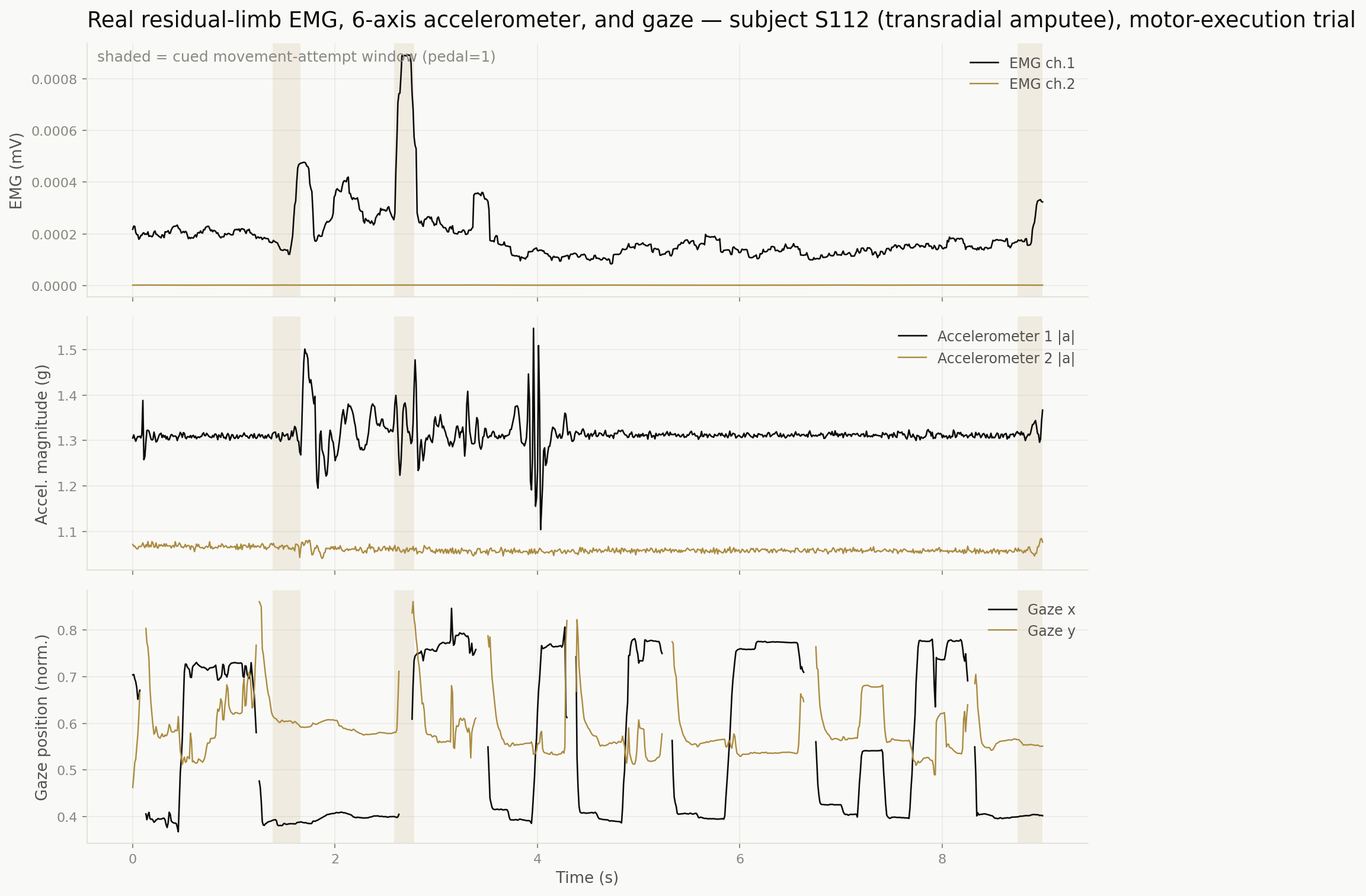
Real EMG, accelerometer, and eye-gaze recordings from a residual-limb sensor session, subject S112 (transradial amputee)
Real sensor data, one subject, one trial — not a simulation. Shaded bands mark the moment the subject was cued to attempt the movement.
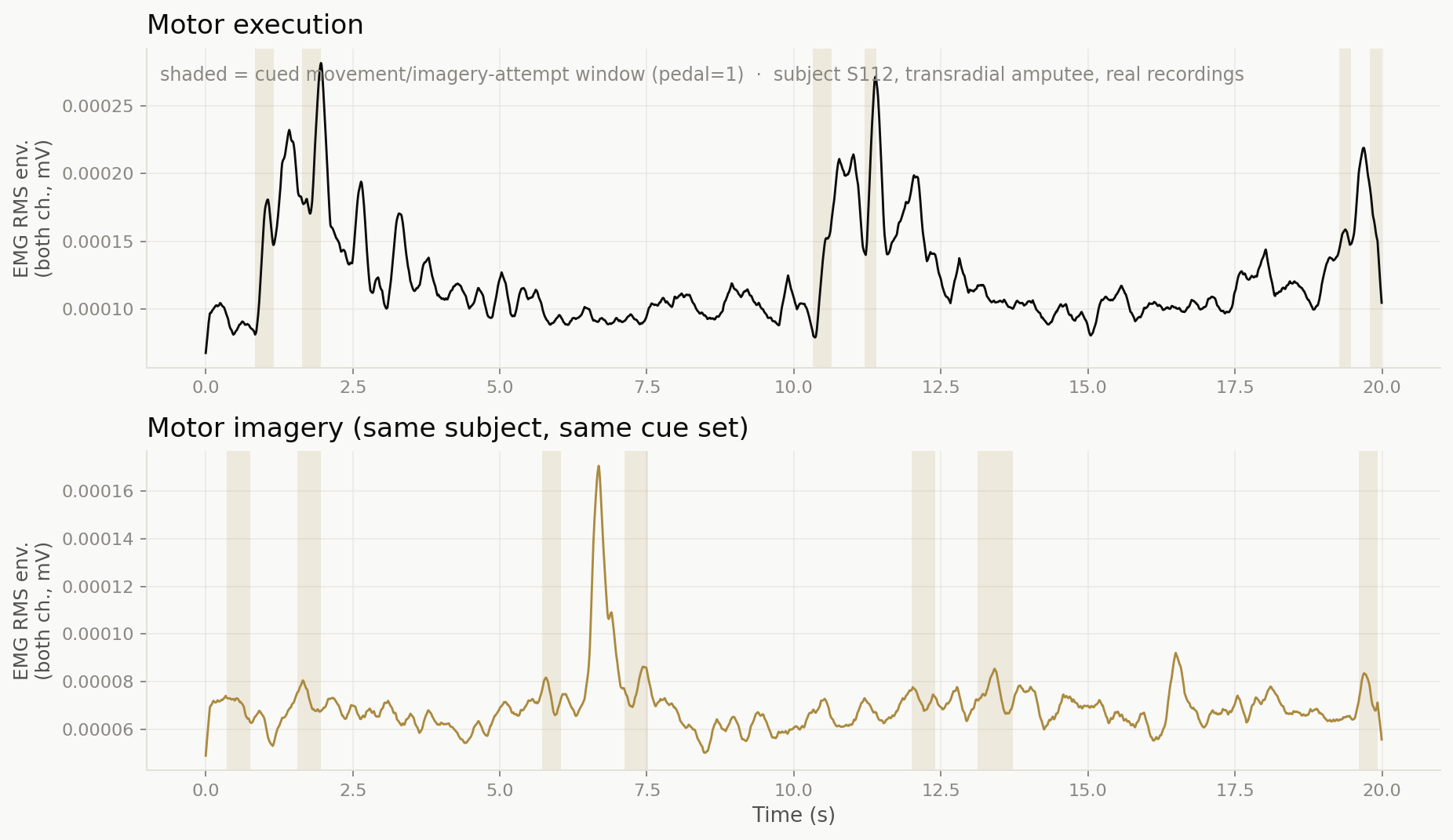
Comparison of real EMG signal during an attempted movement versus the same movement attempted by thought alone, same subject
The actual open research question: residual-limb muscle activity during a real, attempted movement (top) versus the same subject attempting the same movement by thought alone, with no deliberate muscle contraction (bottom) — both are real recorded signals from a real limb-loss case, not a simulation of either. This is the kind of signal Project 26B is studying for a link to phantom limb pain — nothing here is a diagnosis.
Watch it happen

Real EMG from five different transradial/upper-limb amputees in this dataset, played back on a loop — pick a subject below. The glow brightens and dims exactly as their forearm muscles did — brighter means more electrical activity. The right arm is drawn in silhouette because, physically, it isn't there anymore; the glow is what's left of it responding anyway.
Widens how far the glow swings around baseline — applied identically to both sides, so the real-vs-phantom comparison doesn't change. The × numbers below are the real unscaled data and are never affected by this slider.
Real (attempted) movement
actually trying to move the hand
1.00×
of resting baseline
Phantom limb response
attempting the same motion by thought alone — still a real signal
1.00×
of resting baseline
EMG monitor — raw signal, unscaled
Real Phantom
Vertical axis: multiple of this subject's own resting baseline (dashed grey line at 1.0×). Solid lines are the raw quantized EMG magnitude (unsmoothed, straight from the recording); dashed colored lines are the cumulative energy used so far this cycle (1.0× at the end would mean the whole cycle cost exactly as much energy as resting the whole time). Horizontal axis: one full movement-attempt cycle, 0-100%, looped. Shaded band marks the cued movement-attempt window. Nothing on this panel is affected by the visual gain slider above — it always plots the exact recorded values.
Animation paused (reduced-motion preference detected). Real peak activation shown: 2.31× baseline (real attempt) vs. 1.15× baseline (phantom attempt). Total energy used this cycle: 1.19× baseline (real) vs. 0.77× baseline (phantom).
Real recorded EMG, one representative movement-attempt cycle per condition per subject, looped continuously for viewing — not a live sensor feed. Both arms show the same real limb-loss case: the pale arm is what's left of it responding to a genuine attempted movement; the dark silhouette is the same missing limb, producing a real signal from attempting the same movement by thought alone, without deliberate muscle contraction. Glow intensity uses one identical scale for both sides and across all five subjects, so no comparison is visually exaggerated. The visual gain slider above widens that same shared scale for legibility — it applies equally to both sides and all subjects, and never touches the × readout numbers, which stay the real recorded values. The glow, the two readouts, and the monitor below are all driven directly from the quantized (unsmoothed) recorded EMG magnitude, not a smoothed average — an earlier version of this page used a heavily smoothed curve that understated true peak amplitude and signal energy for some subjects; this version doesn't.
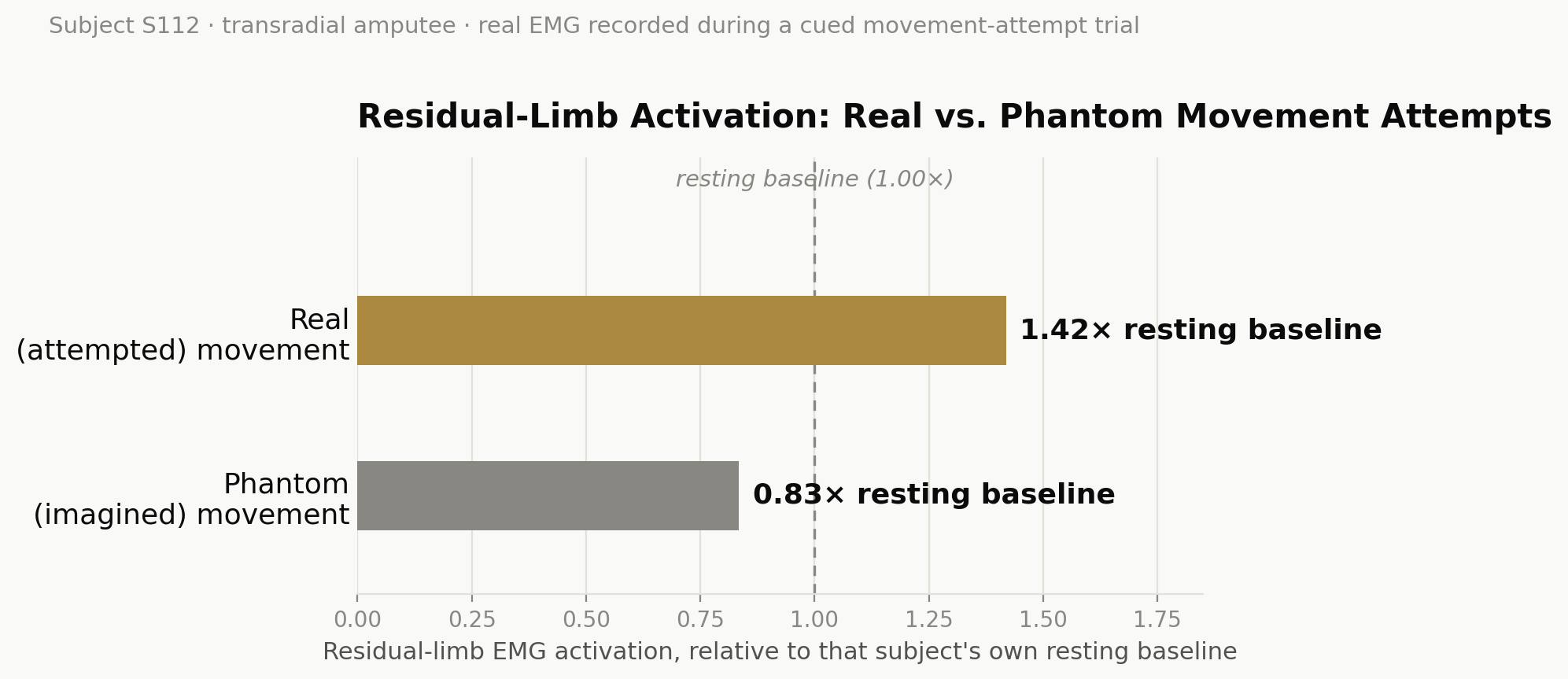
Bar chart comparing residual-limb EMG activation during a real, attempted movement versus the same movement attempted by thought alone, subject S112 (transradial amputee)
The same idea, distilled to one number per condition: for this subject (a transradial amputee), residual-limb muscle activity rose 42% above resting baseline during a real movement attempt, and sat 17% below it when the same movement was attempted by thought alone. Across the 11 amputee subjects in this dataset with usable recordings of both conditions, that direction (real > phantom) holds for some subjects and not others — mean activation index 1.06× for real vs. 0.93× for phantom, not statistically significant at this sample size (paired t-test, p=0.35). That's exactly why we're not calling this a diagnostic signal yet.

A television show got the emotional truth right. We just want the medical truth to keep up.

AEGIS exists on a simple idea: AI can help clinicians see things faster, but the clinician — the human — stays in command of every decision, always. We don't publish a result we can't stand behind, and we don't dress up a small pilot study because that headline would travel further. That standard doesn't change just because the traffic to this page is coming from a TV recap search instead of a medical journal.

If a character's storyline is why you're here, thank you for staying this long. If a real diagnosis is your own, or a family member's — we mean it: talk to your own clinician about your own case. This page tells you what we know and don't. It isn't where you get treated.

Character, not diagnosis

Fictional character vs. real actor

Jason Hayes and Clay Spenser are fictional characters. Everything above about their injuries is drawn from the published storyline, not from anything true of David Boreanaz or Max Thieriot personally. We found no evidence either actor has experienced a traumatic brain injury or limb loss in real life.

No show imagery used

Photographs of the cast and stills from the series are copyrighted press material, licensed for editorial use, not general marketing reuse. We chose not to use them here — see the redacted panels above.

Not medical advice

This page is educational, not clinical. If you have symptoms consistent with a brain injury or live with phantom limb pain, please speak with a qualified healthcare provider about your own case.

Not affiliated

AEGIS and Loh Kah Meng are not affiliated with CBS Studios, Paramount, or Netflix. SEAL Team and its characters are the property of their respective owners.

📬 Get new-app alerts